Monday, October 4, 2010

Class 2— October 7— Turn Up the Contrast


Contrast is one of the elements that creates movement and gives pizzazz to a painting. Find a photo that has a good range of values from dark to light. In this class we’ll ask how we can create effective contrast that draws and moves the eye. 
Have you ever noticed that the winning paintings at most shows are high contrast pieces? They have an excellent range of strong light and dark values. Does every winning painting have sock-it-to-you high contrast? Well, maybe not, but it has enough of a range of values that it's effective and interesting. Value is a basic property of color, of course, and is in essence the motor that drives where your viewer's eye moves. You have to control that movement to make your composition compelling, whatever the subject matter might be. 

At this week's class I'll do a demonstration that develops the grayscale underdrawing to create a composition with excellent contrast that moves your eye into the area of interest. We'll discuss the motivating factors and talk a bit about how value and color are linked. 

Find a photo that interests you, with a stimulating value contrast in the area of greatest interest. Bring both a color and grayscale copy of it to class to use for your painting. It can be any subject matter, and any size. 

Look for something like these, which I reduced to grayscale, as well:


(c) photo: Don Ketchek,  'Bobby'


Please bring your paintings from our 3-D class last week so we can discuss that class together. I'll be interested to know how you liked it. 

See you on Thursday!
Deborah

Friday, October 1, 2010

The 3-D Painting class results

What gives depth to a painting? There are several "depth clues" that all of us use fairly routinely and hardly think about, like perspective, value and color shift. But there are a few others that seem elementary but often do not come under scrutiny. I decided to examine these clues and challenge my students to think about them more clearly.


I find that most of us understand one-point linear perspective, which is the convergence of the road, river or railroad tracks in the distance, and even two-point perspective, making both sides of the barn recede. We might not have studied all the rules, but in our minds we get that. 

Aerial perspective, on the other hand, is a tool my students have had drummed into them over and over. John Carlson's Law of Aerial Perspective states: All colors become cooler in color and lighter in value as they recede from the eye, except white. 

The rest of these clues are fairly simple but together can add great depth to a vista.
  • Think about relational proportions, for instance, in which larger objects appear nearer. That can become more complicated when a small object is closer and a large one farther away. They can look about the same size, which may be literally accurate but destroys the illusion of depth.
  • Modeling shapes gives form to objects in the composition, which is another key element in creating three-dimensionality. A well-rounded tree or bush, or modeled mountain or mesa adds to the illusion.
  • Overlapping shapes is another biggie. We all know that things in front overlap things behind. I always tell my students they must paint what's behind before painting what's in front, and part of the reason is this overlapping, which adds more to the illusion. 
  • Your point of view can also contribute depth clues. Think of the ant's eye view verses the bird's eye view. A high viewpoint gives majesty to the vista, while the low one adds drama and intrigue. Both enhance the sense of depth by engaging the viewer in feeling small or large, low or high.
  • Shapes can create depth by contributing directional forces. The shape of masses of value add dramatic depth when seen as one, such as the 'arrow' of a grasses and low-growing shrubbery in the foreground pointing the eye into the distance.

We spent some time looking at a few of my paintings, examining the various depth clues in them. In the portrait the depth is a few inches from the back of the hat to nose tip, accomplished using color, while in the figure painting it's the overlapping of shoulder and chin. In the floral painting (a gouache piece), the clues are color contrasts and dark-light contrasts, along with overlapping shapes. The shapes of the shadows contribute some depth clues to the trees, while linear perspective is at work in the painting of the window.


I asked my students to take some time to sketch out the composition they planned to use for the painting and identify, as well as enhance, some of the depth clues they saw there. Here's a nice drawing done by Adriana:

I saw some very nice work starting to take shape in the class, but will wait until next week to show you some of the results. It seemed to clarify some things for folks, at least making us think more seriously about things we often take for granted.

Good work, gang!
Deborah

Tuesday, September 28, 2010

My first video: the working palette

I thought I'd figure out how to make a video, and decided to upload my first one here so people can see my well-used, dirty pastel palette. This is the real thing, folks, not some shiny, cleaned up version for video!


I hope it's interesting and helpful to see it. The Ludwig pastels I mention are a few of the confetti colors Terry makes. If you haven't tried them, give it a go--what fun to swipe a gold and find bits of red, green and blue making a gorgeous stew on your paper!

You'll also see a 3" foam brush, which is a trusty tool I use every day, and several Colour Shapers, as well as a Sofft sponge, a stick of extra soft vine charcoal, and a 'white' (more black now) plastic eraser.

If I can learn how to make decent video clips, I'll add an occasional ones here to show you how I do things. Let me know how I did...

Monday, September 27, 2010

Class 1— September 30— The 3-D Painting


Perspective, value, color and composition all work together to create depth. We’ll analyze those elements to make a painting that recedes. Bring a photo with a good sense of depth to it and we’ll look more closely at these elements.
Hi gang,

Our class this week, which starts our new session, is devoted to creating depth. The illusion of three dimensions is, to some degree or another, a combination of perspective (linear and aerial), value (paler as it recedes), color (cooler as it recedes), and composition (using overlapping objects, relative size, etc.) working together. 

Find a photograph that creates depth--not a difficult assignment. Unless you point your camera directly at a piece of white paper, for instance, you have some illusion of depth. 
(c) D. Secor
 How deep is the space in a composition like the one above? The depth from elbow to face is no more than a foot, yet key to creating three-dimensionality. What elements are at work here?

(c) photo: 'aphid dew' @ WetCanvas RIL
In the photo above the space between the feeder, the hummer and the distant trees is a matter of a few feet, while in the one below it's a matter of more than 20 miles. Again, what elements create the illusion of space?
(c) D. Secor
We'll explore the idea that some of the same devices are used in each one of these to add the illusion of depth to your painting. 

Please bring your sketch pad and drawing materials with you, along with photos you want to use for paintings, and together we'll explore these key elements that combine to create the illusion of 3-D in your paintings. 

See you on Thursday,
Deborah


Thursday, September 23, 2010

New Class Session Begins September 30--Join Us!

I hope you'll plan to join us for the next eight-week session of classes. As you'll see in the class schedule below, I'm trying some new things geared to honing some skills and thought processes!

If you'd like to join us please contact me.


Class Schedule
September 30-November 18, 2010
                                                      

Class 1— September 30— The 3-D Painting
Perspective, value, color and composition all work together to create depth. We’ll analyze those elements to make a painting that recedes. Bring a photo with a good sense of depth to it and we’ll look more closely at these elements.
Scent of Rain, 12" x 18"

Class 2— October 7— Turn Up the Contrast
Contrast is one of the elements that creates movement and gives pizazz to a painting. Find a photo that has a good range of values from dark to light. In this class we’ll ask how we can create effective contrast that draws and moves the eye.

Class 3— October 14— Night
Find a nighttime photo with an interesting pattern of colorful lights to paint. We’ll analyze what makes the nighttime painting successful, painting on dark paper. We’ll discuss how you can make your own dark colored surface for this painting.

Class 4— October 21— Complexity Behind it All
At this class I’m going to try to help you see and understand better how to approach a complex background that resides behind your subject matter by patterning light and dark, as well as identifying and repeating shapes, colors and textures. Your photo should have something like a tangled forest or textured hillside overlapped by the subject matter in front of it.
Almost Spring, 12" x 18"

Class 5— October 28 — Palette Shift
A subtle shift in color can make a huge difference in mood, so today we’re going to do three small (4x6” to 6x9”) paintings, one in grayscale and two others with a limited value scheme. We’ll slightly shift the palette and see the beauty of using subtle varieties of colors for each one.

Class 6— November 4— Lost and Found
Edges are compelling! Today we’ll work from life, drawing and painting some simple objects that overlap one another. We’ll use “lost and found” edges to sculpt space and move the eye through the composition. Bring three small objects and a background for them, your sketchbook and drawing tools.

Class 7— November 11— Asymmetrical Square
The directional thrust of a square painting is challenging, so today we’ll look at how to make an asymmetrical composition in a square piece. You’re welcome to work from life, if that helps you, or find a photo that you can recompose into a square composition.
Sandia Square, 9" x 9"

Class 8— November 18—Final Critique and Class Potluck
We’ll do an in-depth crit of the paintings done in this class or anything you’re working on outside of class. Food and fun!
For cost and other class information, go to the Upcoming Classes tab at the top of the page.

Monday, September 20, 2010

Class 8— September 23—Final Critique and Class Potluck


Hi gang,

I hope you don't feel like this little gal when you think of final critique! This is always my favorite class, and not just because you all cook or bring such good food. I enjoy seeing your progress and getting a sense of the direction the class as a whole is heading. If you have some insight on that, whether individually regarding your own work, or corporately as part of the class, I'd certainly welcome your thoughts.

Bring any work you want to share, whether done in class or outside it, in any medium. It might be only one painting or it could be a dozen, whatever you want to share. As always, it helps if the work is ready to lean against the wall (or tipped-over tables, as we usually do), and doesn't need the tape removed from each painting. Most times folks display them grouped together on a piece of foam core, mat board or cardboard. You don't need to bring your painting materials. This class is all food and talk.

The point of the critique is to identify your "point of friction", the place where, as you let out the clutch, the vehicle begins to move forward. This is where what you know and do well meets the friction of something you need to learn or move farther into. It could be something simple like learning to control contrast or adding certain values or colors to your palette.  Maybe it's a matter of exploring a particular subject matter. It may be more subtle and complex, such as finding your own voice or style. If you're frustrated because you can't accomplish something, the critique is the place to bring it up and discuss it.

We'll eat first, so bring along a dish to share. As ever, buy it or cook it, whatever works for you. If you have some paper plates, napkins, forks, etc., bring them along, since all those supplies were taken last session, and I don't know what we have on hand any more. The classroom will open at 11:15 this week.

Our next class begins on September 30th. If you have any suggestions for specific classes you would like to see included, let me know now, and I'll be happy to consider including them in the session. I should have a schedule of classes ready this Thursday for you to see at the critique. If you could check your schedule for the next four weeks (9/30, 10/7, 10/14, 10/21) and make sure of your availability for those classes, I'd appreciate knowing this week what you plan to do (if possible.) Please remember the new class policies of no refunds or credits. I have instituted this only because it helps hold the line on increasing costs, and thus keeps the class going. If financial need is keeping you from joining us, please talk to me individually about it. We can work it out!

Starting next session, I'm going to open our final critique to anyone who wants to come, at a cost of $35.00 per person, with  a limit on the spaces available and the number of works shown. Please let your friends know that the next critique is on November 18th at 11:30 a.m. I'll send out announcements previous to that, but pass the word now.

In the future you'll be able to go back over the classes here on the blog, but we started with class four, so I'm adding the schedule. 

Class 1— August 5— 20-Stroke Paintings
To refresh us and get started again, we’ll begin with 20-stroke paintings, however this time you can work in any size and try to paint three or more of them. I suggest you prepare some thumbnail sketches ahead of time, just to sort out the major shapes and values from your photos. That way you can make every stroke count. Extra points for fewer strokes, as always! How low can you go and still express the place well?

Class 2— August 12 — Negatives/Positives
Please bring or find an object or objects that you will use to paint only the negative space (for now.) It can be anything, large or small, simple or complex: a cup, a chair, your hand, a plant, fruit, flowers, whatever! You might also consider bringing a simple background for the object, such as a colored mat board, paper or cloth, if applicable.

Class 3— August 19— Hot, Warm, Cool
Today we’ll make a chart experimenting with temperature. You’ll chart some color combinations and from that you’ll create three small compositions, one with warm, one with cool, and one with hot predominating. Bring paper or canvas large enough to accommodate nine 3x3” experiments, and three surfaces prepared for your small studies.

Class 4— August 26— Increased Scale
Today we’ll do something a little bit different. I want you to work in the range of 16x20” or larger. Bring an excellent photograph and your corners to crop the view. You’ll begin painting in a small area taped off on the page, which will contain the area of interest, then remove the tape and continue the rest of the painting, experimenting to see how the small scale start affects your overall painting. You’re invited to be creative and try various things with this painting.

Class 5— September 2 — Collage
You’ll receive a mystery photograph to paint today. Come prepared to paint a 5x7” painting whether it’s paper or canvas. At the end of the day we’ll assemble our collage of paintings to reveal what we’ve painted.

Class 6— September 9— Memory Painting Exercise
Find a photo you want to paint, carefully composed just the way you want to paint it. You’ll be given ten minutes to memorize it, and then you will paint strictly from memory. You can draw or paint it at home, ahead of time, if you like, or use a photograph that you’ve painted from already, but you will start fresh in class on a new painting.

Class 7— September 16— Emotional Colors
We’ll discuss the link between color and emotion and how it affects the overall mood of a painting. Please bring samples of other artist’s paintings that you feel express a particular feeling or emotion well. Also find a photo that you would like to paint and identify the emotional link you want to achieve (i.e. photo of empty field: loneliness.)

Class 8— September 23—Final Critique and Class Potluck
We’ll do an in-depth crit of the paintings done in this class or anything you’re working on outside of class. Food and fun!

See you on Thursday,
Deborah

Thursday, September 16, 2010

Emotion of Color class results

Moody Sky, 8" x 10"

Color is one of my favorite topics and I think this class was a blast! Above is the painting I did in class (not as a demo.) The challenge was to use a moody looking photograph and enhance the feeling even more using color. It's not finished, but I think it already expresses a sense of foreboding that driving into a storm can bring. You can see the resource pic in the post before this one. I removed all the trees and made it into a sterile desert environment in order to enhance the feeling of exposure, and to remove the darkness of the trees themselves. This gives the sky all the power, since it contains the darkest darks, and creates a subtle warm color that counters the blues, greens and grays of the sky.

First I gave them a test.Feel free to print it and fill in the blanks. You might be surprised, but I also suspect you'll find some strong connections to color and emotion. No, it doesn't matter what the colors are, you can envision and red, yellow, blue, green, orange or purple you want to.


So, of those choices, what color is innocent? Disgusted?Confused?Again, there are no right or wrong answers, but ask a couple of other people to fill in the blanks, too and see if there isn't some agreement. You might be surprised!

In order to further explain the link between color and mood I showed this:


You can see the hastily scrawled list of feelings on the left and these blocks of colors, which have no content whatsoever. There's no 'thing-ness' to get in the way. Take a minute to study each one and choose an emotion from the list that describes the mood created by it. There may be more than one mood, and there are no right or wrong answers, only your opinion. I think this shows you the power of color, independent of anything else. Here, it's all color. In most other compositions the content flavors the response.

For instance, here's my original painting:

I like the pink sunglasses, and used a light yellow and blue to express the beach, summer, sunlight. I wanted to give it a fun mood.


Notice how the shift in palette (made by Photoshopping the original) has enhanced the feeling of heat, as if the sun it too hot and this poor gal is getting beet red. The mood is still cheerful and upbeat, but we want her to get in out of the sun. It's almost painful.


And now it reads completely differently. The blue shift has darkened it enough that we have the feeling it's wrong. It seems a little spooky and sinister. That's the power of color. She's still smiling. There's still a spot of sunlight and a cast shadow on her neck, the beach is still kind of yellow and the sky is blue--but the smile seems to be out of place.

We enjoyed a good discussion and shared our photos. We talked about how we could enhance the feeling we wanted to create. Here are some of the works in progress my students were doing. None of them is finished, of course, but they were looking quite good, I think.
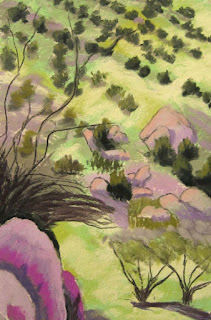
Kris

Carol

Catherine

Adriana
I'll let you decide what you think the gals were expressing in these. It was a very fun experiment, and I think the paintings are strong statements about the emotive power of color.

Good job, gang! Keep going.
Deborah